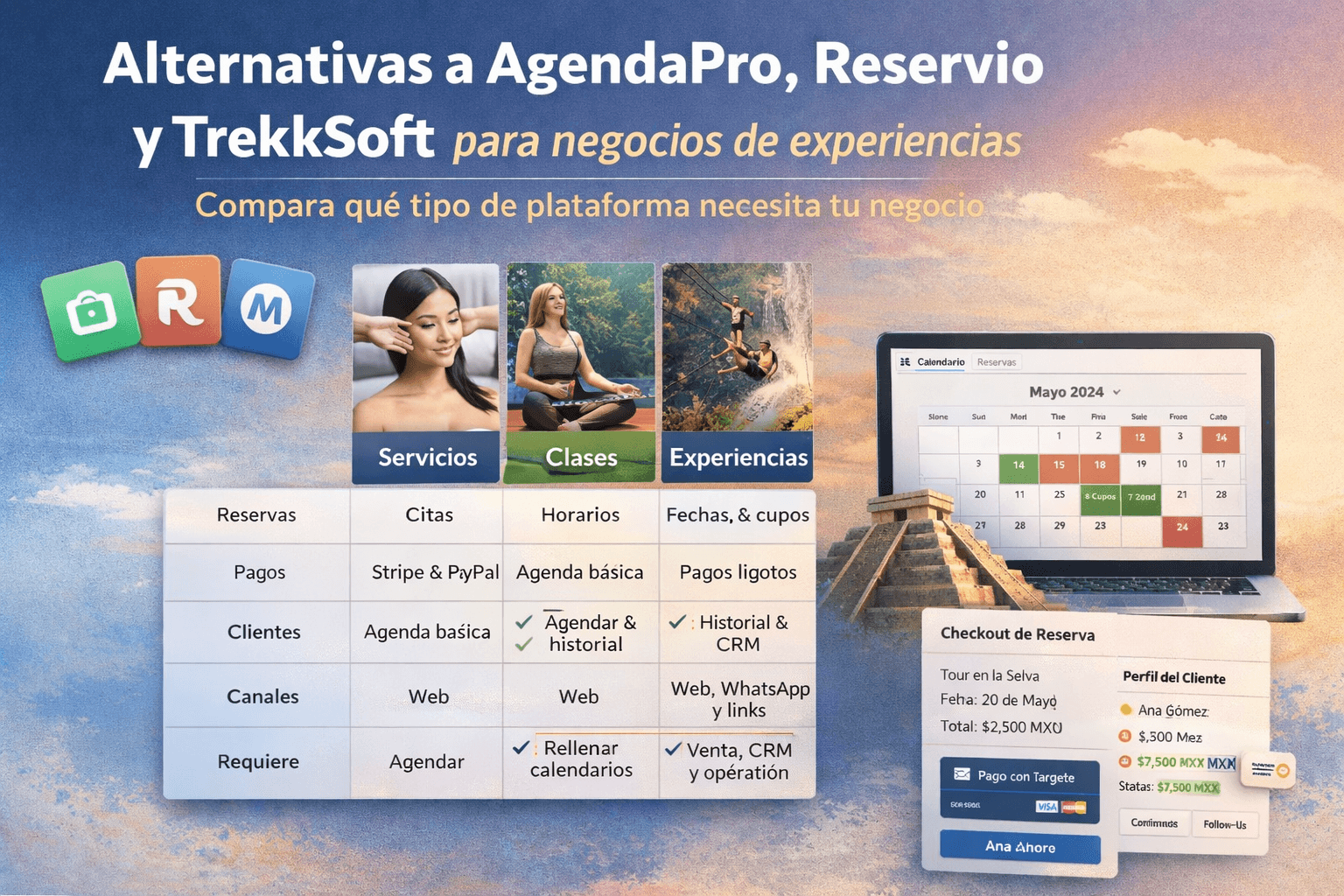
Alternatives to AgendaPro, Reservio, and TrekkSoft for experience businesses
MaunaOne Team
8min read

Alternatives to AgendaPro, Reservio, and TrekkSoft for Experience Businesses
When an experience business begins to professionalize its operation, it often arrives at the same search: finding a platform to manage reservations, payments, customers, and availability without continuing to depend on WhatsApp, Excel, and manual processes.
In that journey, names like AgendaPro, Reservio, and TrekkSoft come up. It makes sense. They are well-known brands with a digital presence and a clear proposition around reservations.
The problem is that many businesses evaluate these tools as if they all solve the same issues. That's not the case.
The correct question is not which platform "is better" in abstract terms.
The correct question is this:
Which one fits better with the type of operation you have today and the business you want to build in the next 12 to 24 months
Because one tool may serve you well for scheduling simple appointments or classes, but fall short if you operate experiences with dates, capacity limits, payments, multiple products, sales links, commercial follow-up, and the need to sell from more than one channel.
This guide helps you evaluate alternatives with a more useful and honest criterion.
The most common mistake when comparing booking software
Most businesses compare platforms based on feature checklists.
They look for:
calendar
payments
reminders
booking page
customer database
That’s not enough.
Two tools might check the same boxes and still function very differently in practice.
What really matters is how they resolve daily operations.
For example:
you can sell an experience with a specific date and limited capacity
you can charge and confirm automatically
you can share the product via link from WhatsApp or ads
you can view the customer's history and follow up
you can operate multiple products without losing order
you can change dates or reschedule without chaos
That’s where a generic tool often starts to fall short.
When a platform falls short for experience businesses
If your business only schedules 1-on-1 appointments or very simple recurring spaces, many solutions may work well.
But if you operate activities like:
tours
workshops
wellness
classes with limited capacity
wineries
gastronomic experiences
events or group activities
then the complexity changes.
You no longer just need a schedule. You need to combine:
dynamic availability
capacity control
integrated payment
reservation by date or session
customer follow-up
sales from multiple channels
visibility of which experience sells best
That’s where it’s worth checking if the tool was designed for something similar to your operating model or if you’re just forcing it to adapt.
What type of business usually chooses AgendaPro
AgendaPro typically enters conversations when the business is very service-oriented, focusing on appointments, professionals, wellness, health, beauty, or classes with a relatively stable schedule structure.
It can be a reasonable option when the main pain points are:
organizing appointments
scheduling staff
reducing cancellations
charging for services or sessions
centralizing basic operations
Where the decision may start to become complicated:
if the business sells experiences more like products with dates than appointments
if you need a more commercial logic to sell via link, campaigns, or direct checkout
if what matters is not just scheduling, but also capturing demand and converting better
if the operational flow depends on capacities, events, and group reservations
It doesn’t mean it’s not useful. It means you need to check if your business is closer to the “service schedule” world or the “operational sale of experiences” world.
What type of business usually chooses Reservio
Reservio tends to position itself well for businesses looking for something simple, accessible, and relatively quick to implement.
That can work in the beginning when the priority is:
to stop using a manual schedule
to start accepting online reservations
to have a functional calendar
to reduce basic administrative load
The risk appears when the business grows and the operation demands more depth.
For example:
different types of products
more commercial control
sales from campaigns
greater reliance on connected payments
more useful CRM
automation around the complete flow
In those cases, a simple tool can feel light at first and limited later.
That trade-off is important.
Sometimes the cheap option at first becomes expensive when migrating hurts later.
What type of business usually chooses TrekkSoft
TrekkSoft enters more into the conversation for tours, activities, operators, and companies in the travel world.
That vertical proximity is relevant.
It doesn't compete from the same angle as a generic schedule.
It may make more sense when the business needs something more focused on activity reservations and operations related to tours.
Still, it’s not enough to assume that just because it’s closer to the vertical, it’s the best option.
You need to review things like:
ease of implementation
clarity of commissions
purchase experience
customer control
commercial flexibility
ability to adapt to Mexico or LATAM
technical and operational complexity of daily tasks
In some cases, a more specialized solution can better address the heart of the product but falls short in other layers like CRM, payment links, simple distribution, or ease of use for small teams.
So, what should an experience business look for as a real alternative?
A good alternative for experience businesses should solve these 6 layers simultaneously.
1. Sales, not just scheduling
Many tools are born to organize operations.
That’s fine, but it’s not enough.
An experience business needs a platform that also helps sell.
That implies:
clear checkout
easily shareable product links
simple sales pages
less friction to pay
the ability to connect the system with campaigns, Instagram, or WhatsApp
If the tool organizes you but doesn’t help you convert, you’ve only solved half the problem.
2. Real management of dates and capacities
Selling an appointment is not the same as selling an activity with availability, capacity, and sessions.
You should check if the tool allows:
to open specific dates
to manage capacities
to block times
to see real availability
to operate recurring or special sessions
to avoid overselling
This is critical for tours, workshops, and group activities.
3. Payments connected to reservations
The system should allow that payment does not live separately from the rest of the flow.
Ideally, the customer should be able to:
choose a date
make a reservation
pay
receive confirmation
And the business should be able to see all that linked to the same record.
When payment is external, the usual problems return:
manual follow-up
extra messages
errors
abandonment
lower conversion
4. Centralized customers
You shouldn’t have to operate customers in one tool and reservations in another.
The right alternative should give you a view of the customer with:
purchase history
previous reservations
notes or context
payments
useful information for follow-up
Without that, the system can serve for operations, but not for building relationships or recurrence.
5. Adaptation to the real acquisition channel
Many experience businesses do not sell only from a main website.
They sell from:
WhatsApp
Instagram
paid campaigns
direct links
partners
salespeople or internal team
Therefore, the right tool should not depend on everything happening within one closed page.
It needs to be flexible enough to operate in the channel that already drives your demand.
6. Reasonable implementation
A bad sign is when the system promises a lot, but to use it well you need:
too much configuration
constant technical support
custom development
excessive training
difficult changes to execute
In medium or small businesses, implementation is also part of the product.
Simple table to compare alternatives
Criterion | What you should evaluate |
|---|---|
Type of operation | Appointments, classes, experiences, tours, events or a mix |
Capacity and dates | If it manages capacities, sessions, special dates, and changes |
Sales | If it has clear checkout, links, and simple payment flow |
Customers | If it centralizes history and follow-up |
Channels | If it works for selling via website, WhatsApp, campaigns, or direct links |
Ease | Implementation time and learning curve |
Scalability | If it will continue to serve you when the volume grows |
Don’t just compare names.
Compare against your real flow.
Signs that a too generic solution is no longer suitable
Here are some pretty clear signs:
your team continues to use WhatsApp too much to close deals
transfers remain a central part of the process
the system doesn’t help you sell via campaigns or links
you can’t clearly see who reserved and who paid
operating date changes is uncomfortable
you feel like you have a schedule, but no centralized business
you still need Excel to complete control
When that happens, it’s often not a matter of the team lacking discipline.
It’s about needing a tool better aligned with the business model.
How to choose between several alternatives without making a mistake
Make this assessment before contracting any platform.
Step 1. Define your real type of business
Don’t say “we are a reservation business.” That’s not helpful.
Define if you're more like:
service scheduling
activity operator
experience business with dates
hybrid business with sales, CRM, and operations
Step 2. Map your current commercial flow
Write down the exact process:
how the customer arrives
where they inquire
where they see dates
where they reserve
where they pay
where you confirm
where you follow-up
You’ll quickly see which layer is broken today.
Step 3. Test with real scenarios
Don’t buy based on a pretty demo.
Request or test these cases:
individual reservation
group reservation
direct payment
rescheduling
cancellation
recurring customer
shared sale via link
Step 4. Review the total cost, not just the monthly fee
Include:
fixed fee
payment commission
implementation
internal team hours
cost to migrate later if it fails
Step 5. Think in 12 months, not 2 weeks
A simple tool may win in speed to start, but lose when your operation becomes more serious.
What type of alternative usually suits experience businesses best
In practice, for experience businesses, a solution that combines four things usually makes more sense:
booking logic with dates and capacity
checkout and connected payments
easy to share links or sales pages
centralized customers and operations
That mix is more important than having dozens of little-used features.
The right platform should not only help you “take reservations”.
It should help you sell better, operate with less friction, and centralize the business.
Conclusion
AgendaPro, Reservio, and TrekkSoft can be valid options depending on the business type, but they do not exactly solve the same problem.
Comparing them as if they were equivalents leads to poor decisions.
If your experience business needs more than basic scheduling, your evaluation should focus on this:
how well the tool sells
how well it operates dates and capacities
how well it connects payments and reservations
how well it centralizes customers
how easy it is to use without creating more work than it eliminates
The best alternative is not the most well-known.
It’s the one that best fits your operation and how you really capture demand.
FAQ
AgendaPro, Reservio, and TrekkSoft serve the same purpose
Not exactly. They may touch on the same general reservation space, but they often respond better to different types of operations.
What should an experience business review before switching platforms?
Calendar, capacities, payments, customers, ease of use, sales channels, and ability to adapt to the real business flow.
When does a generic platform fall short?
When the business needs to manage experiences with dates, groups, connected payments, sales links, campaigns, and more structured commercial follow-up.
Is it worth switching tools just for the price?
No. The monthly cost matters, but the operational cost and the cost of poor implementation tend to weigh more heavily.
What matters more for an experience business: scheduling or sales?
Both, but if the tool doesn’t help you sell and collect with less friction, it ends up being just a prettier calendar.
Before changing systems, check if the real problem in your business is organizing appointments or selling and operating experiences professionally.
That difference completely changes which tool is worth evaluating.
Alternatives to AgendaPro, Reservio, and TrekkSoft for Experience Businesses
When an experience business begins to professionalize its operation, it often arrives at the same search: finding a platform to manage reservations, payments, customers, and availability without continuing to depend on WhatsApp, Excel, and manual processes.
In that journey, names like AgendaPro, Reservio, and TrekkSoft come up. It makes sense. They are well-known brands with a digital presence and a clear proposition around reservations.
The problem is that many businesses evaluate these tools as if they all solve the same issues. That's not the case.
The correct question is not which platform "is better" in abstract terms.
The correct question is this:
Which one fits better with the type of operation you have today and the business you want to build in the next 12 to 24 months
Because one tool may serve you well for scheduling simple appointments or classes, but fall short if you operate experiences with dates, capacity limits, payments, multiple products, sales links, commercial follow-up, and the need to sell from more than one channel.
This guide helps you evaluate alternatives with a more useful and honest criterion.
The most common mistake when comparing booking software
Most businesses compare platforms based on feature checklists.
They look for:
calendar
payments
reminders
booking page
customer database
That’s not enough.
Two tools might check the same boxes and still function very differently in practice.
What really matters is how they resolve daily operations.
For example:
you can sell an experience with a specific date and limited capacity
you can charge and confirm automatically
you can share the product via link from WhatsApp or ads
you can view the customer's history and follow up
you can operate multiple products without losing order
you can change dates or reschedule without chaos
That’s where a generic tool often starts to fall short.
When a platform falls short for experience businesses
If your business only schedules 1-on-1 appointments or very simple recurring spaces, many solutions may work well.
But if you operate activities like:
tours
workshops
wellness
classes with limited capacity
wineries
gastronomic experiences
events or group activities
then the complexity changes.
You no longer just need a schedule. You need to combine:
dynamic availability
capacity control
integrated payment
reservation by date or session
customer follow-up
sales from multiple channels
visibility of which experience sells best
That’s where it’s worth checking if the tool was designed for something similar to your operating model or if you’re just forcing it to adapt.
What type of business usually chooses AgendaPro
AgendaPro typically enters conversations when the business is very service-oriented, focusing on appointments, professionals, wellness, health, beauty, or classes with a relatively stable schedule structure.
It can be a reasonable option when the main pain points are:
organizing appointments
scheduling staff
reducing cancellations
charging for services or sessions
centralizing basic operations
Where the decision may start to become complicated:
if the business sells experiences more like products with dates than appointments
if you need a more commercial logic to sell via link, campaigns, or direct checkout
if what matters is not just scheduling, but also capturing demand and converting better
if the operational flow depends on capacities, events, and group reservations
It doesn’t mean it’s not useful. It means you need to check if your business is closer to the “service schedule” world or the “operational sale of experiences” world.
What type of business usually chooses Reservio
Reservio tends to position itself well for businesses looking for something simple, accessible, and relatively quick to implement.
That can work in the beginning when the priority is:
to stop using a manual schedule
to start accepting online reservations
to have a functional calendar
to reduce basic administrative load
The risk appears when the business grows and the operation demands more depth.
For example:
different types of products
more commercial control
sales from campaigns
greater reliance on connected payments
more useful CRM
automation around the complete flow
In those cases, a simple tool can feel light at first and limited later.
That trade-off is important.
Sometimes the cheap option at first becomes expensive when migrating hurts later.
What type of business usually chooses TrekkSoft
TrekkSoft enters more into the conversation for tours, activities, operators, and companies in the travel world.
That vertical proximity is relevant.
It doesn't compete from the same angle as a generic schedule.
It may make more sense when the business needs something more focused on activity reservations and operations related to tours.
Still, it’s not enough to assume that just because it’s closer to the vertical, it’s the best option.
You need to review things like:
ease of implementation
clarity of commissions
purchase experience
customer control
commercial flexibility
ability to adapt to Mexico or LATAM
technical and operational complexity of daily tasks
In some cases, a more specialized solution can better address the heart of the product but falls short in other layers like CRM, payment links, simple distribution, or ease of use for small teams.
So, what should an experience business look for as a real alternative?
A good alternative for experience businesses should solve these 6 layers simultaneously.
1. Sales, not just scheduling
Many tools are born to organize operations.
That’s fine, but it’s not enough.
An experience business needs a platform that also helps sell.
That implies:
clear checkout
easily shareable product links
simple sales pages
less friction to pay
the ability to connect the system with campaigns, Instagram, or WhatsApp
If the tool organizes you but doesn’t help you convert, you’ve only solved half the problem.
2. Real management of dates and capacities
Selling an appointment is not the same as selling an activity with availability, capacity, and sessions.
You should check if the tool allows:
to open specific dates
to manage capacities
to block times
to see real availability
to operate recurring or special sessions
to avoid overselling
This is critical for tours, workshops, and group activities.
3. Payments connected to reservations
The system should allow that payment does not live separately from the rest of the flow.
Ideally, the customer should be able to:
choose a date
make a reservation
pay
receive confirmation
And the business should be able to see all that linked to the same record.
When payment is external, the usual problems return:
manual follow-up
extra messages
errors
abandonment
lower conversion
4. Centralized customers
You shouldn’t have to operate customers in one tool and reservations in another.
The right alternative should give you a view of the customer with:
purchase history
previous reservations
notes or context
payments
useful information for follow-up
Without that, the system can serve for operations, but not for building relationships or recurrence.
5. Adaptation to the real acquisition channel
Many experience businesses do not sell only from a main website.
They sell from:
WhatsApp
Instagram
paid campaigns
direct links
partners
salespeople or internal team
Therefore, the right tool should not depend on everything happening within one closed page.
It needs to be flexible enough to operate in the channel that already drives your demand.
6. Reasonable implementation
A bad sign is when the system promises a lot, but to use it well you need:
too much configuration
constant technical support
custom development
excessive training
difficult changes to execute
In medium or small businesses, implementation is also part of the product.
Simple table to compare alternatives
Criterion | What you should evaluate |
|---|---|
Type of operation | Appointments, classes, experiences, tours, events or a mix |
Capacity and dates | If it manages capacities, sessions, special dates, and changes |
Sales | If it has clear checkout, links, and simple payment flow |
Customers | If it centralizes history and follow-up |
Channels | If it works for selling via website, WhatsApp, campaigns, or direct links |
Ease | Implementation time and learning curve |
Scalability | If it will continue to serve you when the volume grows |
Don’t just compare names.
Compare against your real flow.
Signs that a too generic solution is no longer suitable
Here are some pretty clear signs:
your team continues to use WhatsApp too much to close deals
transfers remain a central part of the process
the system doesn’t help you sell via campaigns or links
you can’t clearly see who reserved and who paid
operating date changes is uncomfortable
you feel like you have a schedule, but no centralized business
you still need Excel to complete control
When that happens, it’s often not a matter of the team lacking discipline.
It’s about needing a tool better aligned with the business model.
How to choose between several alternatives without making a mistake
Make this assessment before contracting any platform.
Step 1. Define your real type of business
Don’t say “we are a reservation business.” That’s not helpful.
Define if you're more like:
service scheduling
activity operator
experience business with dates
hybrid business with sales, CRM, and operations
Step 2. Map your current commercial flow
Write down the exact process:
how the customer arrives
where they inquire
where they see dates
where they reserve
where they pay
where you confirm
where you follow-up
You’ll quickly see which layer is broken today.
Step 3. Test with real scenarios
Don’t buy based on a pretty demo.
Request or test these cases:
individual reservation
group reservation
direct payment
rescheduling
cancellation
recurring customer
shared sale via link
Step 4. Review the total cost, not just the monthly fee
Include:
fixed fee
payment commission
implementation
internal team hours
cost to migrate later if it fails
Step 5. Think in 12 months, not 2 weeks
A simple tool may win in speed to start, but lose when your operation becomes more serious.
What type of alternative usually suits experience businesses best
In practice, for experience businesses, a solution that combines four things usually makes more sense:
booking logic with dates and capacity
checkout and connected payments
easy to share links or sales pages
centralized customers and operations
That mix is more important than having dozens of little-used features.
The right platform should not only help you “take reservations”.
It should help you sell better, operate with less friction, and centralize the business.
Conclusion
AgendaPro, Reservio, and TrekkSoft can be valid options depending on the business type, but they do not exactly solve the same problem.
Comparing them as if they were equivalents leads to poor decisions.
If your experience business needs more than basic scheduling, your evaluation should focus on this:
how well the tool sells
how well it operates dates and capacities
how well it connects payments and reservations
how well it centralizes customers
how easy it is to use without creating more work than it eliminates
The best alternative is not the most well-known.
It’s the one that best fits your operation and how you really capture demand.
FAQ
AgendaPro, Reservio, and TrekkSoft serve the same purpose
Not exactly. They may touch on the same general reservation space, but they often respond better to different types of operations.
What should an experience business review before switching platforms?
Calendar, capacities, payments, customers, ease of use, sales channels, and ability to adapt to the real business flow.
When does a generic platform fall short?
When the business needs to manage experiences with dates, groups, connected payments, sales links, campaigns, and more structured commercial follow-up.
Is it worth switching tools just for the price?
No. The monthly cost matters, but the operational cost and the cost of poor implementation tend to weigh more heavily.
What matters more for an experience business: scheduling or sales?
Both, but if the tool doesn’t help you sell and collect with less friction, it ends up being just a prettier calendar.
Before changing systems, check if the real problem in your business is organizing appointments or selling and operating experiences professionally.
That difference completely changes which tool is worth evaluating.
Explore More Articles
Boost your experience business Start using MaunaOne today
The all-in-one booking platform with powerful features: automatic billing, management via WhatsApp, and complete control of your operation.


Boost your experience business Start using MaunaOne today
The all-in-one booking platform with powerful features: automatic billing, management via WhatsApp, and complete control of your operation.
Boost your experience business Start using MaunaOne today
The all-in-one booking platform with powerful features: automatic billing, management via WhatsApp, and complete control of your operation.